Introduction
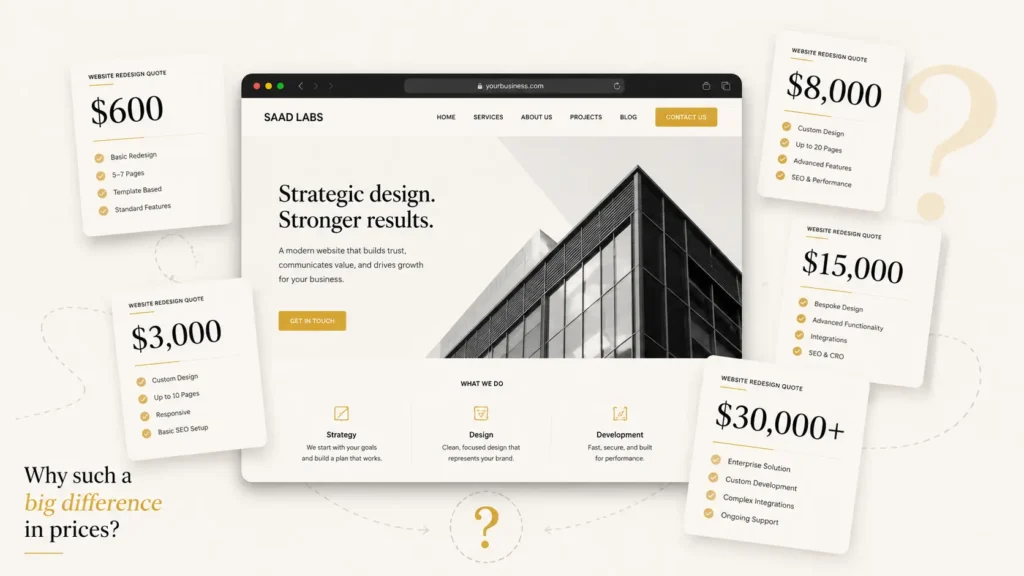
If you’ve searched for website redesign cost, you’ve probably run into something confusing. One agency quotes $600. Another quotes $15,000.
Both are proposing to redesign a website. So why the gap?
The honest answer: “website redesign” isn’t one service. It’s a label attached to dozens of different combinations of design, content, strategy, and technical work.
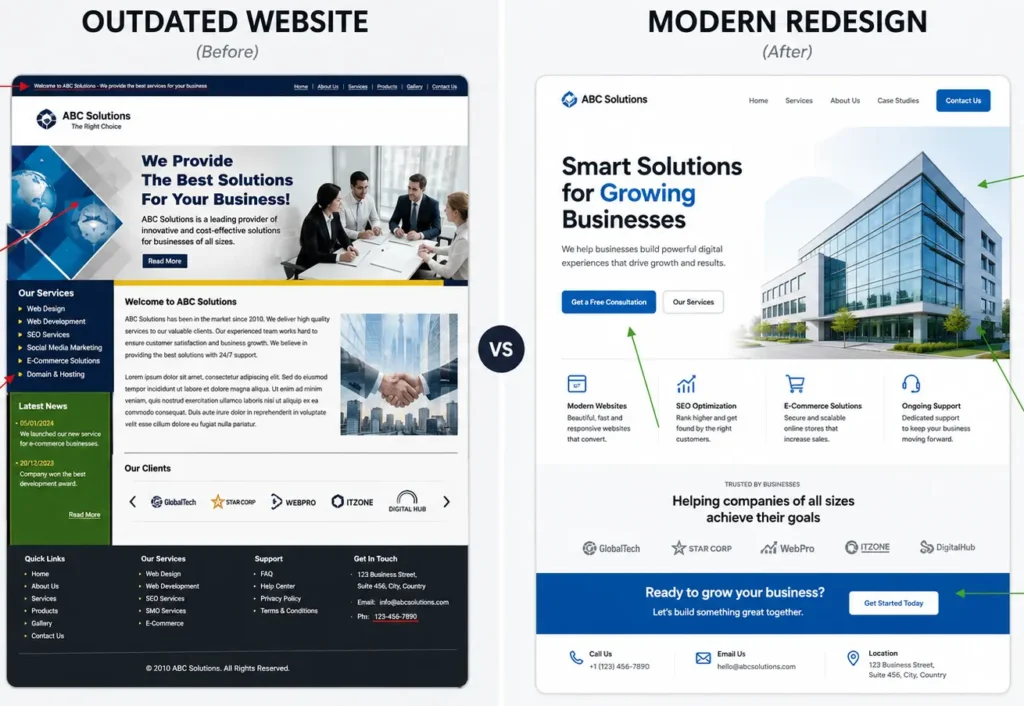
A $600 redesign might swap your old template for a newer one. A $15,000 redesign might include new messaging, custom design, SEO structure, and a plan for how the site should perform six months from now.
Neither price is automatically wrong. But they’re rarely buying the same thing — which is exactly why comparing website redesign quotes across providers can feel like comparing apples to spreadsheets.
This guide breaks down what actually drives website redesign pricing, what a realistic small business website redesign cost looks like, and — maybe more usefully — when you might not need a full redesign at all.
Here’s something worth sitting with before we go further: your website can look professional and still quietly lose potential customers. Price isn’t the only variable that matters. What the price is attached to matters more.
Table of Contents
- Why Website Redesign Costs Vary So Much
- Average Website Redesign Cost by Website Type
- What Actually Determines Website Redesign Cost?
- Cheap vs Expensive Website Redesigns
- When You Don’t Need a Full Website Redesign
- Common Website Redesign Mistakes
- Questions to Ask Before Hiring a Web Design Agency
- Hidden Costs Many Businesses Forget
- How to Budget for a Website Redesign
- Frequently Asked Questions
- Still not sure what your website actually needs?
Why Website Redesign Costs Vary So Much
Two business owners can ask five different agencies for a quote and get five very different numbers. This isn’t random. It usually comes down to five things: goals, business type, complexity, expertise, and deliverables.
Different goals. A nonprofit wanting a simple, clean site has different needs than an e-commerce brand trying to increase average order value. The goal shapes almost everything else about the project.
Different businesses. A one-person consulting practice and a 40-person law firm may both want “a professional website.” The law firm often needs more pages, more approval steps, and more content review.
Different complexity. A five-page brochure site is a different undertaking than a site with booking systems, membership logins, or product filtering. More moving parts generally means more hours.
Different expertise. A freelancer working solo charges differently than a small agency with a designer, developer, and strategist. Neither is automatically better — but the price reflects the team behind it.
Different deliverables. Some quotes include only design and development. Others include copywriting, photography, SEO setup, and training on how to update the site yourself.
One factor many business owners overlook: two companies can quote a similar price and still deliver very different value. Ask what’s included, not just what it costs.
Ask yourself: the last time you got a quote, did you know exactly what was in it — or just the final number?
Average Website Redesign Cost by Website Type
Exact prices are hard to promise responsibly, since so much depends on scope, region, and who you hire. What’s more useful is understanding realistic ranges and what typically falls inside them, based on published 2026 industry pricing data rather than a single agency’s opinion.
| Website Type | Typical Range (2026) | What’s Usually Included |
| Landing page | $300 – $3,000 | Single page, one goal, minimal copy, basic design |
| Small business website | $2,000 – $20,000 | 5–10 pages, custom design, basic SEO setup, contact forms |
| Corporate / mid-market website | $20,000 – $75,000 | Multiple departments, approval workflows, brand guidelines |
| Portfolio website | $800 – $6,000 | Visual-first design, project galleries, minimal copy |
| Membership website | $5,000 – $30,000+ | Login system, gated content, payment integration |
| E-commerce website | $5,000 – $50,000+ | Product catalog, cart, payment processing, inventory tools |
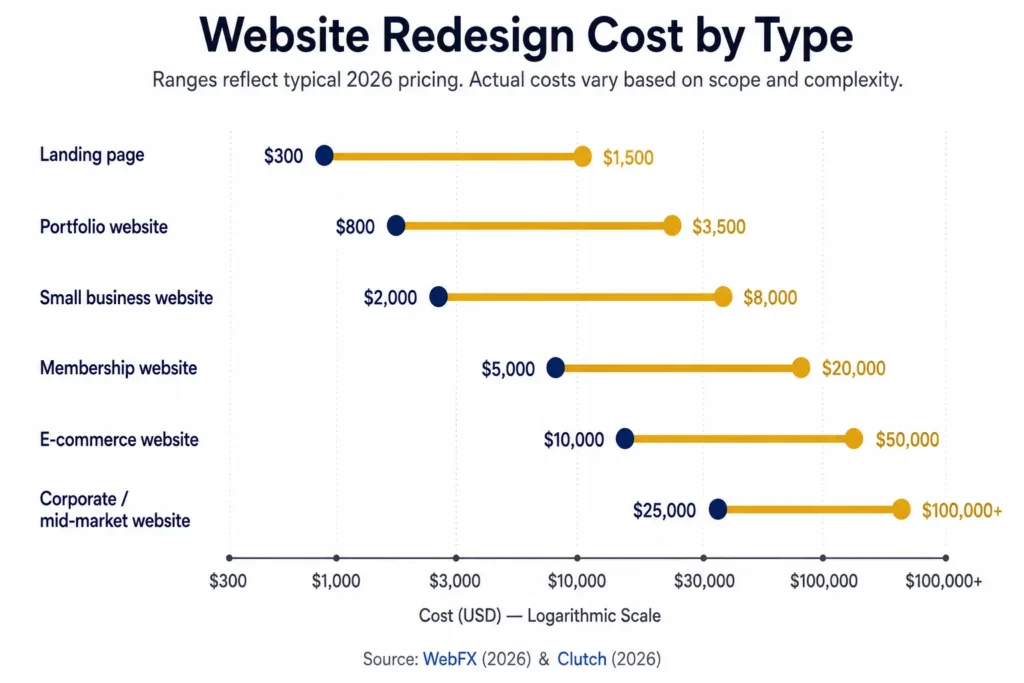
These figures reflect a range across published sources, not one agency’s number. WebFX puts typical redesign pricing at roughly $3,000–$75,000 depending on whether you hire a freelancer, a small agency, or a full-service firm, while Clutch’s 2026 buyer data shows most small business buyers spending under $10,000 on their most recent project, even though the median full website project across all business sizes lands closer to $36,500. That gap between the “typical buyer” and the “median project” is a useful reminder that averages can be misleading — your realistic number depends far more on scope than on any single published figure.
These ranges also shift depending on your region, the provider’s experience, and how much custom work is involved. A small business website redesign cost in a major city often runs higher than the same scope in a smaller market, simply because of local rates.
Here’s the part that tends to surprise people: two businesses can pay the exact same $5,000 for a redesign. One sees a noticeable increase in inquiries within a few months. The other sees almost no change at all.
The difference usually isn’t the price. It’s what was actually redesigned — the messaging, the structure, the offer clarity — versus what just got a new coat of paint.
What Actually Determines Website Redesign Cost?
Most pricing guides stop at a bullet list. Understanding why each item adds cost is what actually helps you make a good decision.
Number of pages. Each added page needs its own layout, content, and review, so more pages generally means more time.
Content writing. Professional copywriting takes research, drafts, and revisions. If you’re not writing your own content, this can be a meaningful part of the budget.
Custom design. Templates are faster and cheaper because the design decisions are already made. Custom design means someone is solving your specific layout and branding problems from scratch.
SEO. Technical SEO — proper headings, page speed, structured data, mobile indexing — takes specialized knowledge. This is different from simply writing keywords into a page.
Conversion copywriting. There’s a difference between words that describe your business and words that guide someone toward taking action. The second kind often costs more because it requires strategy, not just writing ability.
Branding. If your logo, colors, or overall identity need work alongside the website, that’s a separate — and valuable — project layered onto the redesign.
Photography. Custom photos of your team, product, or location cost more than stock images, but they often build more trust with visitors.
Mobile optimization. For many businesses, mobile traffic makes up more than half of all visits. Making sure everything works cleanly on a small screen takes real testing time, not just a checkbox.
Performance optimization. A slow website doesn’t just frustrate visitors — it can quietly reduce how many people ever reach your best sales message, because many leave before the page finishes loading.
CMS migration. Moving your content from one platform to another, say from Squarespace to WordPress, takes technical care so nothing breaks or disappears in the process.
E-commerce functionality. Payment processing, inventory syncing, and cart logic all involve more testing, and more things that can go wrong if rushed.
Accessibility. Making a site usable for people with visual, motor, or cognitive impairments involves specific coding standards, and increasingly, legal considerations.
Third-party integrations. Connecting your website to a CRM, email tool, or scheduling system takes setup time and ongoing upkeep.
Forms. A simple contact form is quick to build. A multi-step form with conditional logic and email routing is a different level of work.
Booking systems. Real-time scheduling tools need to sync with calendars and avoid double-bookings, which is more complex than it looks from the outside.
CRM integration. If leads need to flow automatically into your sales system, that connection has to be built and tested carefully.
Here’s a question worth sitting with: are you paying for features your customers don’t actually use? Some redesigns quietly include tools that sound impressive but rarely get touched — that’s budget that could go toward the things that actually move the needle.
Cheap vs Expensive Website Redesigns
Price alone doesn’t tell you what you’re getting. It helps to compare what typically comes with each end of the spectrum.
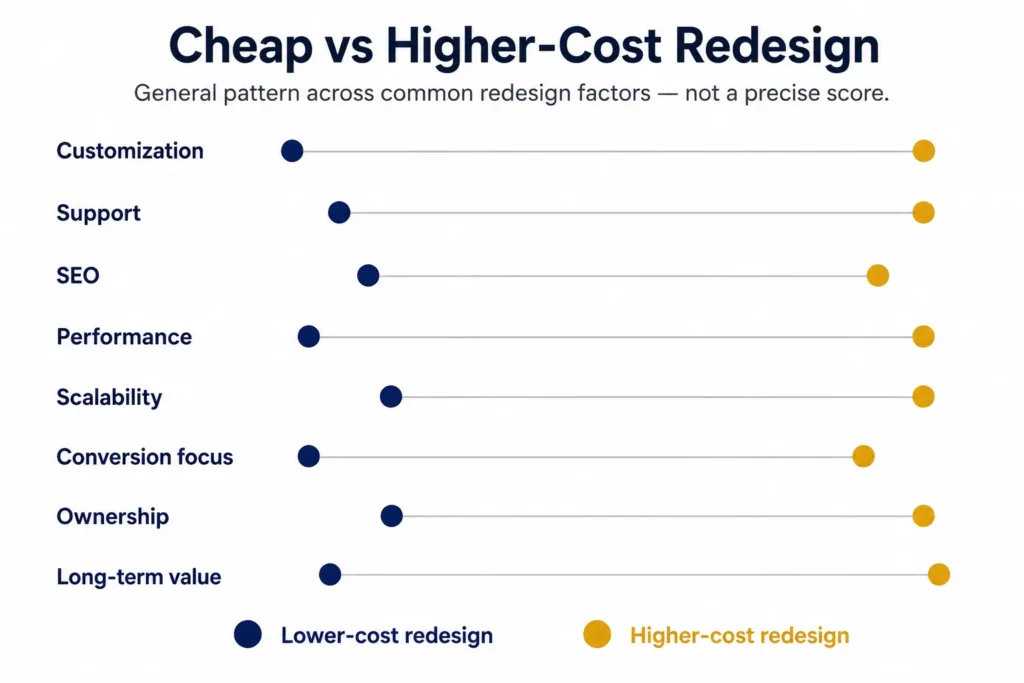
| Factor | Lower-Cost Redesign | Higher-Cost Redesign |
| Customization | Template-based | Built around your specific business |
| Support | Often limited after launch | Ongoing support frequently included |
| SEO | Basic or none | Structured, technical SEO built in |
| Performance | Often untested | Speed and technical performance optimized |
| Scalability | Can be harder to expand later | Generally built to grow with the business |
| Conversion focus | Looks nice | Designed around a specific action |
| Common mistake | Sometimes tied to a platform | Usually fully owned by you |
| Long-term value | May need another redesign sooner | Tends to last longer before needing a rebuild |
Neither option is automatically wrong. A lower-cost redesign can make sense for a business testing a new idea. A higher-cost redesign can make sense for a business that depends heavily on its website for revenue.
The more useful question usually isn’t “cheap or expensive.” It’s “does this match what my business actually needs right now?”
When You Don’t Need a Full Website Redesign
This might be the most important section in this guide, and it’s the one most agencies skip.
Not every website problem needs a full rebuild. In many cases, a full redesign is the most expensive way to solve a problem that a smaller fix could have handled.
If your homepage is the weak point
you may only need to improve that one page — its messaging, layout, and first impression — rather than rebuild the entire site around it.
If your site feels fine but loads slowly
speed optimization alone can sometimes fix the biggest source of lost visitors, without touching the design at all.
If your site looks good but doesn’t show up in search results
the issue may be SEO structure, not design. A redesign won’t necessarily fix rankings if the underlying SEO problems aren’t addressed directly.
If your content is outdated but the layout still works
updating your writing, offers, and photos might solve more than a full visual overhaul would.
Ask yourself: when was the last time you looked at your website like a first-time visitor, instead of the owner? Sometimes the fix isn’t a new website — it’s fresh eyes on the one you already have.
Here’s the part worth remembering: the most expensive redesign isn’t always the one with the highest invoice. In many cases, it’s the one that fails to solve the problem it was actually hired to fix.
Questions to Ask Before Hiring a Web Design Agency
Most of the redesign disasters we’ve seen during website reviews weren’t caused by bad design. They were caused by decisions made before the design work even started.
What exactly is included in this quote?
A vague answer here can be a warning sign, since specifics matter more than the total number.
Who owns the final website files?
In some arrangements, the agency retains control, which can make it harder to leave later.
Will I be able to update the site myself afterward?
This affects your future costs, since some platforms require the original developer for every small change.
What happens if I want changes after launch?
Knowing whether revisions are included, and for how long, can prevent surprise fees.
Is copywriting included, or will I provide the content?
Content often takes longer than expected, so this changes your timeline and budget.
How is SEO handled, if at all?
A beautiful site with no SEO foundation may struggle to be found in search results.
What’s the expected timeline, and what could delay it?
A realistic timeline protects you from being caught off guard mid-project.
Can I see examples of similar projects you’ve completed?
Past work in a similar industry or scope is often more useful than a general portfolio.
What ongoing costs should I expect after launch?
Hosting, maintenance, and plugin fees are easy to forget when comparing initial quotes.
How will we know if the redesign worked?
If there’s no plan to track results, it’s harder to know whether the investment paid off.
One factor worth remembering: the cheapest quote and the most expensive quote can both skip asking what your business actually needs. The right questions often matter more than the price tag.
Hidden Costs Many Businesses Forget
The quoted price is rarely the full picture. These costs tend to surface after the contract is signed.
- Hosting — where your website lives online, usually billed monthly or yearly.
- Maintenance — updates, backups, and security monitoring that keep the site running safely.
- Premium plugins or tools — some features, like bookings or advanced forms, require paid add-ons.
- Content writing — if it wasn’t included upfront, you may need to budget for it separately.
- Photography — custom images often cost extra unless specifically included in the quote.
- Domain renewal — a small but recurring cost that’s easy to forget until it lapses.
- Email hosting — professional email addresses sometimes carry their own separate cost.
- Third-party integrations — CRMs, scheduling tools, and payment processors often have their own monthly fees.
- Future updates — websites aren’t “set it and forget it,” so budgeting for occasional updates helps avoid letting the site quietly go stale.
If your contact form stopped working tomorrow, how long would it take you to notice? Ongoing maintenance is often what stands between “working fine” and quietly broken for weeks.
How to Budget for a Website Redesign
Instead of asking “what’s the lowest price I can find,” it’s often more useful to ask “what return do I need this website to generate?”
A website that costs $3,000 but brings in a handful of extra clients a year can be a strong investment. A website that costs $500 but produces no measurable change may not be a bargain at all — it may just be a smaller loss.
A simple way to think about your website redesign budget:
- Start with your goal. More leads? More online sales? Better first impressions for referrals? The goal shapes the scope.
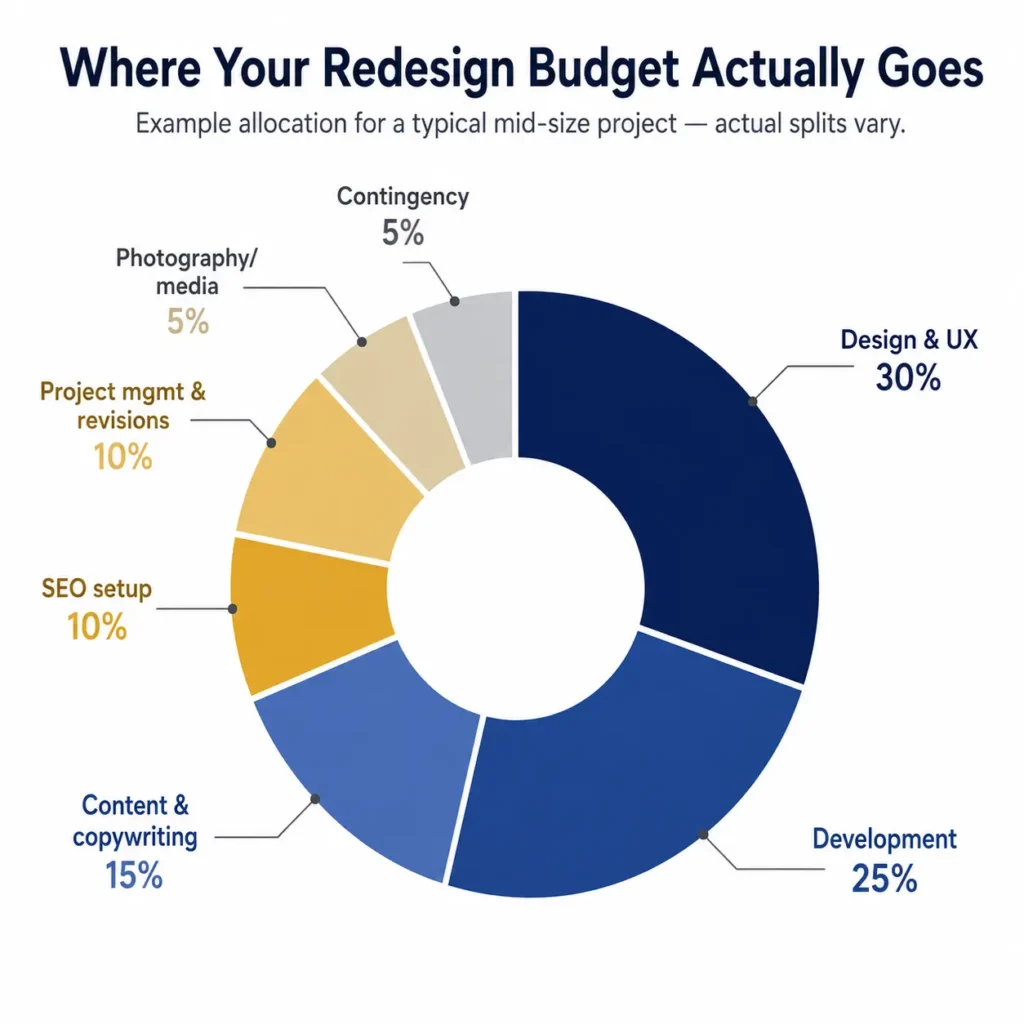
- Separate one-time costs from ongoing costs. Design and development are one-time. Hosting, maintenance, and content updates are ongoing.
- Budget for content, not just design. A beautifully designed page with weak messaging often underperforms a plainer page with clear, persuasive writing.
- Leave room for the unexpected. Scope often shifts slightly once a project starts, so a small buffer can prevent stress later.
Two businesses can invest similar amounts into a redesign and walk away with very different results. Often, the difference isn’t the size of the budget — it’s whether the budget was spent on what actually influences visitor behavior, like clarity, trust, and ease of use.
If you’ve noticed your website isn’t converting the way you expected, it may help to look at the underlying signs first. [7 Signs You Need a Website Redesign Before It Starts Costing You Customers] walks through the specific warning signs worth checking before committing to a full rebuild.
Frequently Asked Questions
How much does a website redesign cost?
Published 2026 industry data puts most small business redesigns somewhere between $2,000 and $20,000, though simple landing pages can cost less and complex e-commerce or membership sites can run well beyond that. The right number depends on scope, content needs, and the provider’s experience level.
How often should I redesign my website?
There’s no fixed timeline that fits every business, but many companies revisit their website every 2 to 4 years, or sooner if their offerings, branding, or audience have changed significantly. A redesign is often less about age and more about whether the site still reflects the business accurately.
Is redesigning a website worth it?
In many cases, yes — but usually only when the redesign targets a real problem, like unclear messaging, a weak mobile experience, or poor conversion paths. A redesign done without a clear goal can end up looking nicer without actually improving results
Can I redesign my own website?
For simple sites with a handful of pages, a DIY redesign using a website builder can work reasonably well. For more complex needs, like custom functionality, SEO strategy, or conversion-focused copywriting, professional help often produces a stronger return.
How long does a redesign take?
A simple redesign might take a few weeks, while a more complex site with custom features, content development, and multiple review rounds can take two to four months or more. Timelines usually stretch when content isn’t ready before design work begins.
Still not sure what your website actually needs?
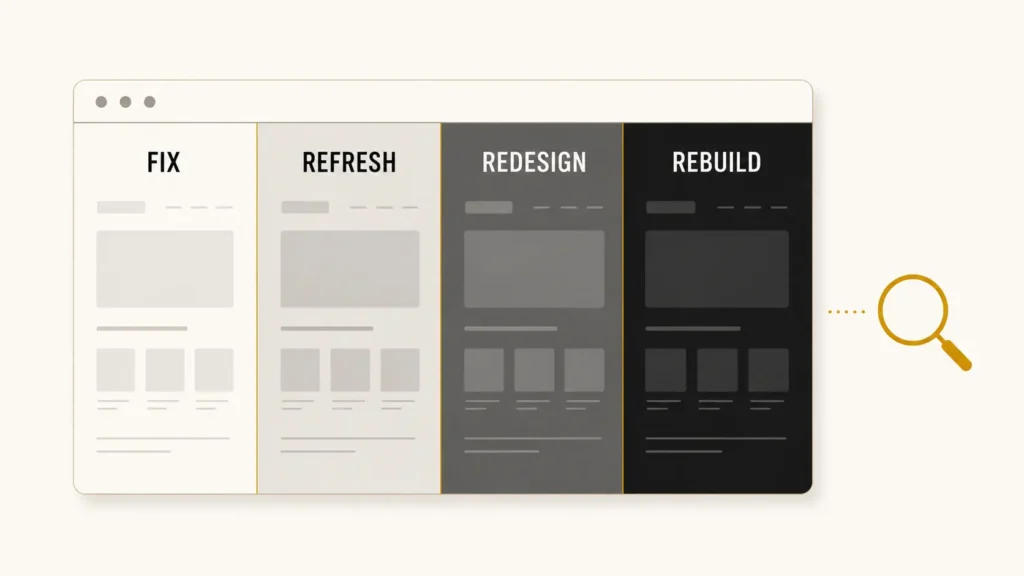
Still have questions? Get in touch and we’ll be happy to discuss your website and whether a redesign is the right next step., we offer a free website audit that looks at exactly the areas covered in this article — page speed, mobile usability, content accuracy, conversion paths, and technical SEO health — and tells you plainly whether you’re looking at a redesign, a refresh, or something more specific like a fix to your Website Development foundation, your CRM Automation setup, or how well your site is set up to support WhatsApp Automation and AI Automation for lead follow-up. No pressure, no generic sales pitch — just a clear picture of where things stand.
Not sure whether you need a full redesign yet? Start with these 7 signs you need a website redesign.